Items
Template
Institution
1–16 of 16
Advanced search
-
 National Bioethics Advisory Commission Executive Order 12975 established the National Bioethics Advisory Commission in 1995 as genetics, cloning, and other biomedical developments pressed federal agencies for ethical guidance. The Commission first met in 1996 and continued through a period of rapid debate about research involving human participants and human biological materials. Its reports addressed cloning, research involving people with mental disorders, stem-cell research, international clinical trials, and protections for human participants. Among them were Cloning Human Beings (1997), Ethical Issues in Human Stem Cell Research (1999), and two 2001 reports on international research and human-participant protections.
-
 Advisory Committee on Human Radiation Experiments Disclosure of Cold War human radiation experiments raised questions about consent, secrecy, health risks, and federal accountability. President Clinton established the Advisory Committee on Human Radiation Experiments in January 1994 to examine that record and consider what government owed the people affected. The Committee investigated past experiments, evaluated historical and contemporary standards, and issued a 1995 final report addressing disclosure, remedies, and protections for research participants. Its archival inquiry made the ethical assessment of government-sponsored experimentation a matter of public record.
-
 Office for Human Research Protections In June 2000, the US Department of Health and Human Services established the Office for Human Research Protections after federal oversight of human-subject research had grown beyond the earlier NIH Office for Protection from Research Risks. The move placed responsibility for these protections at a higher level within HHS. OHRP administers assurance and institutional review board registration programs, oversees compliance, and issues guidance and education on federal human-subject protections. Such administrative work gives research-ethics rules a continuing means of implementation.
-
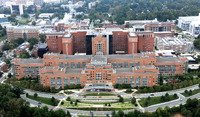 NIH Clinical Center Department of Bioethics The NIH Clinical Center launched a dedicated bioethics department in late 1996 within a federal research hospital. Its location matters: investigators and clinicians there encounter ethical questions as research and care take place, not only when an external commission is convened. Ezekiel J. Emanuel became the department's first Chief in 1997. The department conducts conceptual, empirical, and policy research; trains bioethicists; and provides ethics consultation and advice to investigators and review bodies. These activities make ethical analysis part of the continuing practice of clinical research at NIH.
-
 Johns Hopkins Berman Institute of Bioethics A cross-university faculty interest group developed into a formally established Johns Hopkins bioethics institute in 1995, with Ruth Faden as founder and director. The Berman Institute brought ethical inquiry across the university's schools as questions of public health, research, justice, and clinical care increasingly met. The Institute supported interdisciplinary research, education, and public engagement across research ethics, population health, justice, and clinical practice. Its cross-school structure gave bioethics a university-wide institutional setting rather than confining it to one professional program.
-
 American Society for Bioethics and Humanities Three professional societies consolidated in January 1998 after their members approved a merger the previous year. The American Society for Bioethics and Humanities brought established communities in bioethics, health humanities, and ethics consultation into one national association. Its creation followed decades in which these interests had developed through separate organizations. ASBH provided a shared professional forum and developed resources for health-care ethics consultation, including Core Competencies for Healthcare Ethics Consultants and a professional code. Those materials addressed the practice and responsibilities of consultation as bioethics became more established in health-care institutions.
-
 Kennedy Institute of Ethics At Georgetown University, physician André E. Hellegers established the Kennedy Institute of Ethics in 1971 with Kennedy family support. Medicine's expanding technical choices had become matters for theologians, philosophers, social scientists, and clinicians to study together. The Institute gave that exchange a university-based research and teaching home. Its scholars and library staff built tools for a field still learning how to locate its own literature: the Bibliography of Bioethics, the Bioethics Research Library, and the Encyclopedia of Bioethics are part of that history. The Institute also sustained interdisciplinary teaching and research across medical ethics and the life sciences.
-
 The Hastings Center Daniel Callahan and Willard Gaylin founded the Institute of Society, Ethics and the Life Sciences in 1969, when new powers in medicine and biology were outpacing the places available for sustained ethical discussion. Later known as The Hastings Center, the independent institute brought scholars and practitioners from different fields into continuing conversation outside both government and the university. The Center established a durable setting for interdisciplinary research on health care and the life sciences. The Hastings Center Report, first published in 1970, carried that work to scholarly and public audiences. Its institutional contribution was to make such inquiry a continuing practice rather than a response assembled anew for each controversy.
-
 Ethical, Legal, and Social Implications Research Program The Ethical, Legal, and Social Implications (ELSI) Research Program was established as an integral component of the Human Genome Project to identify and address ethical, legal, and social issues arising from genomic research.
-
 President's Commission for the Study of Ethical Problems in Medicine and Biomedical and Behavioral Research A federal bioethics commission created by Congress in 1978, with presidential appointments announced in 1979, that operated from 1980 to 1983 and advised the President and Congress on ethical problems in medicine and biomedical and behavioral research.
-
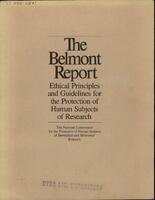 National Commission for the Protection of Human Subjects of Biomedical and Behavioral Research Federal commission established by the National Research Act of 1974 to study ethical issues in biomedical and behavioral research involving human subjects and to develop ethical principles, guidelines, and recommendations for their protection.
1–16 of 16